Wednesday, July 11, 2007

Tolerance of Charismatic Gifts

2) Tolerance of Charismatic Gifts

This is the second part of a 5-part essay on why I will not be (and you should not be either) joining the Evangelical Presbyterian Church any time soon.

Now this critique certainly places me in a precarious theological position with my more evangelical colleagues. I find myself becoming more and more "Orthodox" in my Reformed theology and have come to be in full agreement with the early Church fathers: John Chrysostom, Augustine of Hippo, Origen (even if our Roman Catholic friends think he is a heretic), and Justin Martyr as well as the Princeton School of Theologians including Charles Hodge, B.B. Warfield, and J. Gresham Machen among others who claim that the miraculous works of the Spirit have ceased. In other words I believe that Scripture testifies that the works of the Spirit including prophecy, healing and speaking in tongues ceased with the Apostles and the finishing of the canon of Scripture. I am certainly not saying that miraculous events cannot happen (I would never handcuff the Sovereignty of the Father) but that these gifts of the Holy Spirit no longer manifest themselves outside of the Apostolic Age (cf: Eph. 2:20; 1 Cor 13:8-10; Hebr. 2:3-4; Gal 1:8; Rev. 22:19).

In the Reformed confessions (especially Westminster since it is the only Confession of the EPC) there is not to be found one mention of the continuation of the Spiritual gifts listed above. The confessions fail at one spot to give any credence to the idea that the gifts of the Holy Spirit mentioned in 1 Corinthians 12 for example are to be continued to this day. In fact when mentioning the work of the Holy Spirit in the life of the Church neither the Scots, the Second Helvetic, Heidelberg, or Westminster mention any of the aforementioned gifts to be normative or even available to the believer.

The EPC's official position seems to be seeking some type of middle ground between the Orthodox Reformed view laid out above and those of Pentecostals and Charismatics. The EPC says:

Some would require that Christians manifest a particular gift, such as speaking in tongues, as evidence of a deeper work of the Spirit within. Others would have us believe such a gift is no longer available or acceptable. As a Reformed denomination, we adhere strongly to our belief in the sovereignty of God, a belief that does not allow us either to require a certain gift or to restrict the Spirit in how He will work. Rather, we call upon all Christians to open their lives unto God’s Spirit to fill, empower, and “gift” as He sees fit.

While the EPC claims to not "require the manifestation of a particular gift" the paragraph prior to the quote above seems to do just that when it says, "Regardless of what term is used, we recognize this deepening work of the Holy Spirit in the life of the believer as being both valid and necessary, producing evidences of His presence in the process." The official position lists as "examples of these gifts" the gifts of healing, speaking in tongues and prophecy (as spoken in I Corinthians 12, Romans 12, Ephesians 4, and I Peter 4.) which the Reformed and Ante-Nicene flatly deny as being works outside the Apostolic tradition.

This tolerance of Charismatic gifts in light of Scripture and the Reformed confessional witness I believe is outside the bounds of Reformed Orthodoxy. Though the EPC's claim to be "reformed" will be examined in another article I can honestly say the broadness of the Evangelical Presbyterian Church's views on the Charismatic gifts is out-of-step with Westminster and the rest of the Reformed faith.


See here for the full text of the EPC's position paper on the Charismata

Monday, July 09, 2007

1) Local Option is Still Local Option

This is the first part of a 5-part essay on why I will not be (and you should not be either) joining the Evangelical Presbyterian Church any time soon.


1) Local Option is Still Local Option

One of the main issues driving congregations to seek dismissal from the PC(U.S.A.) is that they conclude that the PUP Report will move the denial of GLBT ordination (and other controversial issues which may or may not crop up) from a mandatory church-wide ordinance to a rule that can be "scrupled" at the presbytery level. Allowing presumably for Presbyteries to have "local option" on GLBT ordination. I have included an example of the critique of Recommendation #5 and a defense of Recommendation #5. (These links are not necessarily the only critiques/defenses but to give one who does not understand the arguments a basic primer.)

The main fear, that I feel is justified, is that Presbyteries that favor GLBT ordination will have candidates for ministry effectively "scruple" G-6.0106b and therefore not have them subject to the code of conduct that the Church as a whole has voted to be required of those seeking ordination and those who are currently ordained. Effectively Recommendation #5 enables the personal conduct of Pastors and other ordained persons to be at the discretion of the ordaining body, which is the Presbytery in the case of Ministers of the Word and sacrament. While this was true before the PUP Report, according to then and current Church law, what this particular ruling means is that an individual now has the power to deny any national ordinance over and against anything that they find "binds their conscience", thereby giving the individual power over the collective wisdom of the Book of Order when it comes to ordination. This power goes against the basic premise of the Presbyterian form of government that seeks unity in Doctrine and matters of discipline. I believe we fail to be a connectional body at all if we make things as pivotal as ministerial ordination a local option or a "non-essential".

What does this all have to do with the PC(USA) and the EPC? Simply the EPC's Book of Order claims that Women's ordination is to be a "non-essential" belief and thus is left up to individual Presbyteries as to whether or not to ordain women, effectively making women's ordination a "local option". The major problem I see is that
the churches that are seeking dismissal nearly always cite the aforementioned encroaching "local option" as being one of their main reasons for asking to be excused from their current denominational allegiance. So the question begs to be asked, "If you hold ministerial ordination to be an essential that requires church-wide subscription while in the PC(USA) why do you seek dismissal to a denomination that sees ordination to be a non-essential?"


See here for the EPC's official statement on Women's Ordination.


Thursday, July 05, 2007

5 Reasons Why:

The Evangelical Presbyterian Church Is Not For Me...
And Should Not Be For You

I attended the now defunct Faith Presbyterian Church, EPC in Fredericksburg, VA from April 1999 to July 2001. Now looking back at that experience and through research I have done for friends interested in the EPC I am of the opinion that the Evangelical Presbyterian Church is not a viable destination for those in the Presbyterian Church (U.S.A.) who are truly looking for an Orthodox and Reformed Presbyterian Denomination. Below are listed 5 reasons (of which there may or may not be more) why I believe this to be so. By this time next week you will have a fully annotated and detailed critique of each point I have listed. This listing is not exhaustive and is open to instruction, clarification, and disagreement. However, I do hold that the items presented below are an adequate and truthful representation of the positions, polity, and practice of the Evangelical Presbyterian Church. I hold with good conscious that my critiques are accurate both in spirit and in letter. It is not the purpose of this analysis to denigrate or cast into doubt the witness of the EPC but to say that the Evangelical Presbyterian Church in its current form does not fully represent Reformed and Presbyterian orthodoxy as exemplified in the confessions, practices, and theology of Reformed Orthodoxy.

1) Local Option is Still Local Option

2) Tolerance of Charismatic Gifts

3) A Free and Unordered Worship Service

4) A Disordered and "Open" Interpretation of Reformed Theology

5) Presbyterian Polity in Name Only


Thursday, June 28, 2007

To Catechize or not To Catechize? That is the Question...


My daughter Lily just turned one the other day and it sparked a conversation in my house about how we were going to educate, not just her but future children we may have. I grew up in a Christian home where Sunday worship attendance was not an option. I can remember vividly being forcefully dragged to church more than once dressed in my blue superman footie pajamas. While this was true from age 0-18 for me (the dragging not the footie pajamas), my wife on the other hand, did not grow up in a particularly Christian home. Her upbringing involved church attendance but it was spotty at best and often entailed going to a Southern Baptist church with her paternal grandfather one week, toddling off to a United Methodist church another week with her maternal grandmother, and every now and then departing with her father to a Presbyterian church the next with many missed weekends in between. Yet one thing we came to realize despite our wildly different attendance patterns at Sunday worship growing up was that neither of us received any consistently direct instruction from our parents in between Sundays (at least until I was in communicants class that is, my mother tried to catechize me in 6 weeks!). Also being that I am studying for the ministry and my wife had a post-high school conversion we speculated on the relative importance of parents catechizing their children. I mean we turned out o.k. right?

This is of course not the point. The mere fact that we are where we are today is by the grace of God not by any direct causation of our lack of mid-week parental instruction. We decided then as we did not have any contemporary examples of family catechizing that we would look to ,as many of my fellow compatriots have begun to do, look back at a time before our parents, even our grandparents, for a day in the past where it was common, strike that, expected that parents would catechize their children at home. What we found in a seemingly odd way was to prove the old adage true. 100 years ago atheists knew more about Scripture and doctrine than we ourselves do today. This caused us quite a lot of soul-searching and wailing with gnashing of teeth thereby causing us to come to the realization that catechizing our children was not just something were going to do but something we had to do.

Our next challenge was seeking out how to catechize our children. While we thought about just using the shorter catechism and "dumbing it down" we thought it would be better to seek professional help. We found up-to-date catechisms that look great and we also found old tried and true books that my grandfather mailed to me. While we look to study up ourselves before the kid(s) get old enough to teach we have made it a little mission of ours in our "community" to help parents understand the importance of family devotions and catechizing sessions not just for mere instruction but for the health of the family because there is a lot of truth to the old saying, "The Family that Prays together stays together."

Tuesday, June 26, 2007

Two Book Recommendations

I am currently reading two wonderful books as a distraction to the Greek class I am taking this summer (by the way Greek is 100 times easier for me than Hebrew). Here they are:


The Reformed Doctrine of Predestination
by Loraine Boettner


This book is an excellent resource for pastors looking for help in teaching the "laity" about the Reformed Doctrine of Predestination, just like the title implies :). It is in an easy to understand format with more than enough Scripture references to keep you busy for hours. Boettner's prose is light and gives even the most basic reader no troubles. He even includes chapters on the most common critiques of Predestination by Arminians and others to enable your congregations the ability to fight off attacks from their neighbors.


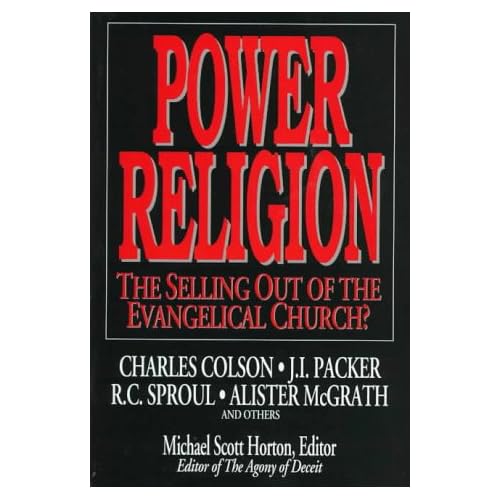
Power Religion:
The Selling Out of the Evangelical Church?
ed. by Michael Horton
w/ essays by Charles Colson, J.I. Packer, R.C. Sproul, Alister McGrath, and others.
A work that gives a detailed and disciplined polemic against the so-called "power gospel" that is currently infesting the "Evangelical" world. Although the book was written way back in the mid-90's it is
eerily current and equally full of keen insights and bothersome revelations about the future of the American Church.

Thursday, June 21, 2007

Finally A New Post


Preaching as a Sacrament

Those of us being ordained in the Presbyterian Church are going to be called Ministers of the Word and Sacrament. But what is the Word and why are we going to be ministers of it? The Second Helvetic Confession (the second confession in our Book of Confessions) defines Word as being the canonical books of the Old and New Testament as the Church has held it in esteem for two thousand years. But the Second Helvetic Confession goes one step further when speaking of the ministers relation to the Word when at the top of the fourth paragraph of the first chapter it says these words, “The Preaching of the Word is the Word of God.” . How does that strike you? Let the words sink in for a moment…what are you feeling? Pressure maybe? Do you believe this? That the words that you hear on a Sunday morning are the words of God? The question we must ask ourselves is how do we value the 15-20 minute sermon during worship when we check our text messages and examine the persons head in front of us or count the number of fleur-de-leis on the back wall. Do we hold preaching with the same value as the writer of the 2nd Helvetic? Maybe if we did we would expect more than simple stories and clichés from our pulpits fit more for a nice speech at the Rotary or the Lions Club than for true exposition from Scripture. We have coddled our minds to believe that the sermon is not meant as a time for learning or teaching from Scripture about the will God has for us in our lives but as an occasion for mere moralistic tales of “practical life” receding the original presentation of Scripture. The call today is supposedly for an orthopraxis (right work) not an orthodoxy (right doctrine) focus of the Christian worldview. We live in a time of anti-intellectualism in the Church where we want pastors to give us a system of right action not a system of right belief. It is the position of the Confessions and creeds of our church that this is not the correct way to receive the Word. The Westminster Shorter Catechism in questions 88-90 and the Westminster Larger Catechism in questions 155-160 share with the 2nd Helvetic this same view of Scripture and the preaching from thereof. You may be asking now what does this have to do with me? What is required of me in the exposition of the Word? Question 160 of the Larger Catechism calls for the persons in the pew to approach the Word with “diligence, preparation, and prayer, examine what they hear by the Scriptures (alone), receive the truth with faith, love, meekness and readiness of mind, as the Word of God.” The question is asked then how can anyone do this if they are not paying attention to or actually receiving from the pulpit the reading and exhibition of the Word?

Wednesday, February 14, 2007

Sorry about my two-month long absence from Posting

My apologies for being so tardy in my keeping up with this blog. Life can sometimes get in the way of fun and engaging speech. I still promise to finish my writings that I promised back in December on the dangers of the Big box churches. Between school and supply preaching not much time has been available for the upkeep of this blog. I am currently helping to establish an online student blog at PTS that you can find here:

ptslogos.blogspot.com

I also have been preaching every sunday for the past two months as well as establishing contacts for Field Education next year. Hopefully I will be able to keep this blog operational. ?If not you can always check out my writing at PTS Logos as I am on the editorial board. If you have any questions/comments please let me know.

Benjamin P. Glaser

Just How Pro-Life Are You Really?

This is an excellent article I recently found by Michael Horton. The man is beyond measure in his genius among modern theologians.

Just How Pro-Life Are You Really?
Michael S. Horton, D.Phil.
(First published in Modern Reformation, July/Aug 1992 issue)

This essay first appeared in the July/August1992 issue of Modern Reformation magazine, when it was under the auspices of CURE (Christians United for Reformation), the predecessor to White Horse Media.

Readers familiar with CURE know that we are a group committed to recovering the essence of the Christian message. That means that what you see and hear from us will usually be in the form of doctrinal discussions, issues, and debates written with the thinking layperson in mind.

Nevertheless, there are some practical issues that walk that razor's edge between faith and practice, to the point where it is difficult to tell whether one who engages in a certain practice is actually denying a certain essential doctrine by doing so. If, for instance, one were to cast one's gaze on an attractive body at the beach for more than passing appreciation (it's not difficult to figure out in which part of the country I live), that would be a sin (lust, since many of us have forgotten), but it would not involve a matter of doctrine. I can and, in fact, do engage in sins that do not affect my faith in God, in Christ, or my convictions about the way in which I am saved. While sin tolerated can often undermine confidence in any doctrine that fails to flatter our own indulgences, most of our daily failures to conform to God's revealed will are of a practical rather than doctrinal sort.

But, as I say, there are exceptions. Abortion is one such exception. In order to engage in this serious sin, a Christian must actually deny a cardinal doctrine of the Christian faith. He or she must deny that God is the Sovereign author of life who alone has the power and right to give and take away human breath, and we also deny the creature we destroy his or her dignity as an image-bearer of God himself. In Christian belief, the significance of human beings over all other species of animal life resides in the image of God (imago Dei) stamped on each person, as an artist signs his masterpieces. Although God created all things, only humans bear his likeness, and they bear it from conception. As Calvin put it, "Though the primary seat of the divine image was in the mind and the heart, or in the soul and its powers, there was no part even of the body in which some rays of glory did not shine" (Institutes 1:15.3). Bavinck, the great Reformed dogmatist, argued that "as long as Man remains Man, he bears the image of God," however tarnished and effaced.

If this doctrine is lacking in the church, surely it will be lacking in society. Before the late Francis Schaeffer, a Reformation thinker, reminded the evangelical and fundamentalist world of this biblical doctrine, there was virtually no response from the evangelical church to the atrocity of abortion. Roman Catholics, of course, had a theological impetus behind their opposition, but it was obscured by their inclusion of birth control as well as abortion.

And now, thanks to the efforts of the Schaeffers and their many co-laborers, a wide cross section of the evangelical movement supports the protection of human life in its most vulnerable phase. Clearly, humanity is determined by the imago Dei, not by concepts such as "viability." Nevertheless, because we evangelicals over the last two centuries have been given to feverish activity without much theological reflection ("Don't bother with all that 'head stuff' – let's just get out there and get it done!"), we are single-issue people. We can only handle one issue at a time. As important as the abortion debate is, the anger that people such as Francis Schaeffer felt in response to it was motivated by a theological conviction--the same well-spring that produced anger at the pollution of the environment (cf. his freshly released Pollution & the Death of Man), outrage at the racism rampant in evangelical circles (cf. Two Contents, Two Realities), and frustration over the injustices of the powerful over the weak.

The abortion debate has been led, like the abolitionist and civil rights movements, as a protest against the oppression of the weak by the strong, picking up on the rich biblical language. "Blessed is he who has regard for the weak" (Psalm 41:1); God "will deliver the needy who cry out, the afflicted who have no one to help. He will take pity on the weak and the needy and save the needy from death. He will rescue them from oppression and violence, for precious is their blood in his sight" (Psalm 72:12-14). And yet, while many evangelicals oppose abortion, there is a curious silence on nearly every other issue where the pro-life ethic, commanded by Scripture, is at risk. One cursory glance at a concordance will reveal how concerned God is about the treatment of the homeless, the poor, the weak, the minorities ("aliens and strangers"), and others too often marginalized.

Words like "oppress," and pejorative barbs from God about "you cows of Bashan on Mount Samaria, you women who oppress the poor and crush the needy and say to your husbands, 'Bring us some drinks!'" (Amos 4:1). "'1 will tear down the winter house along with the summer house; the houses adorned with ivory will be destroyed and the mansions will be demolished,' declares the Lord" (Amos 3:15). The people of God are entrusted with a special obligation to social justice: "Defend the cause of the weak and fatherless; maintain the rights of the poor and oppressed. Rescue the weak and needy" (Psalm 82:3-4). God hates oppression with the same intensity with which he hates abortion, but are we as consistent in our righteous indignation?

Like abortion, apartheid is a theological as well as an ethical question. To deny life and justice to the unborn or to the un-white is not only a serious sin (such as selfishness or racism), but a deliberate system, complete with biblical proof-texts twisted beyond recognition. While those committed to being faithful to the Christian creeds and Reformation confessions declared apartheid in South Africa a heresy, evangelicals here at home have shown more ambivalence. While Jerry Falwell and other leaders of the Christian Right courageously defended the human rights of the unborn, Falwell returned from his trip to South Africa declaring that Archbishop Desmond Tutu, whose pleas for a peaceful transition from apartheid to democracy have kept south Africa from bloodshed thus far, was "a phony" and urged Christians to support the racist government of P.W. Botha. In the meantime, Jessie Jackson expressed outrage at Democratic presidential nominee Bill Clinton's criticisms of a rap song encouraging black violence against whites. When will "reverends" transcend pagan party lines?

Think of our other issues involving the doctrine of the image of God. It is the motivation behind our concern for the victim of a savage murder; our horror at seeing children searching for food in garbage bins behind a restaurant while their mothers hold up signs that read, "Will Work for Food and Diapers." It is that conviction that breaks our heart when we see a prostitute selling her body to keep alive, while others (including those who participate in the same industry through pornography and other forms of sexual entertainment) pour shame and contempt on her. It is that conviction, that religious belief, that binds us to our neighbors and to their interests, regardless of whether they are believers or share our same values or our ethnic, cultural, or linguistic heritage. Not long ago, a friend and I went through the drive-through window at a fast food spot. The fact that the server had a thick foreign accent, characteristic of fast food franchises in Southern California, and that my friend never shied away from making his racism a matter of public record, made me cringe as I prepared for the inevitable. Sure enough, this friend made some typically racist remark. The sad thing is, he's a pastor. The odd thing is, he's a rabid opponent of abortion. But is he consistently pro-life?

Evangelicals raise no qualms when the United States commits millions to Israel or spends millions on a military campaign to free a tiny, but wealthy, oil state with no regard for democracy, but when it comes to talking about the emergency in Somalia, Africa, with hundreds dying every day from starvation, the sentiment seems to be, "We have our own problems here at home." Evangelicals rightly protest the murder of the unborn and decry the silence of those who refuse to defend those who have no voice to defend themselves. Nevertheless, that same silence hovers secretly over the same impassioned group when children die senselessly after they are born. Shouldn't there be an outrage of equal proportions? Isn't life life? Or are we just caught up in the glitz and glamour of political debates? Are we really pro-life?

Until Christians put their theology first, their activism will be little more rationally motivated than that of Hare Krishnas passing out flowers in airports. We will be moved along, one issue at a time, by charismatic and energetic leaders and our internal contradictions (such as calling ourselves "pro-life" when in truth we rarely speak up for the poor and oppressed after they're born) will not win for evangelicalism respect in the eyes of the world for having the courage of its convictions. What convictions? Activism, agendas, and practical involvement are not convictions. Indeed, these things mean nothing without convictions, and convictions come from deeply held beliefs about God and ourselves. And folks, that's theology.

Tuesday, December 12, 2006

The Dangers of Evangelicalism

At the site of yet another "evangelical" pastor resigning after succombing to Homosexual desires (see: http://www.denverpost.com/ci_4817067) I feel the need to write about the danger that evangelicalism (as is exemplified by the mega-church movement) poses to the Church Catholic. Here are Four Bullet Points that I will expound on with following Posts. If you have any insight or questions you would like answered please feel free to post messages.

1) Lack of Pastoral Oversight


2) Lack of Historical Perspective


3) Lack of Eucharistic Awareness


4) Lack of Creedal Association/Foundation

Thursday, December 07, 2006

O Little Town of Bethlehem

O Little Town of Bethlehem, how still we see thee lie! Above thy deep and dreamless sleep the silent stars go by, yet in thy dark streets shines the everlasting Light; the hopes and fears of all the years are met in thee tonight. O holy Child of Bethlehem!
Descend to us, we pray; Cast out our sin and enter in, Be born in us to-day. We hear the Christmas angels. The great glad tidings tell; O come to us, abide with us, Our Lord Emmanuel!

Phillips Brooks wrote that wonderful hymn while riding back to his Boston home after a particularly moving Christmas Eve service in the year 1865. He had visited the actual town of Bethlehem the previous summer and had been struck by the serenity of that small and meager town. Bethlehem in the time of Christ is estimated to have had a population around 500 people. Even small towns can be used by God to further his glory. This is a motif which comes up again and again in the Old and New Testaments. We are reminded of the verse from the Sermon on the Mount that Blessed shall be the meek for they shall inherit the earth. This little backwoods town of Bethlehem was to be the site of the birth of Our Savior, Our Redeemer, Our King. Of course Bethlehem was no ordinary town. Bethlehem was the site where we read in Genesis 35:19 that Rachel the wife of Jacob was buried. Bethlehem was the place where we read in Ruth 4:11 that Ruth and Boaz were married. And who were Ruth and Boaz? Ruth and Boaz were the proud parents as we read in the end of chapter 4 in Ruth of a little boy by the name of Obed. Who is Obed? Obed was the father of Jesse. And who is this Jesse? Seems to me that this Jesse is an important fellow? But does anyone remember who Jesse is? That is correct. Jesse is the father of the David. And for the purposes of the City of Bethlehem what is important about the fact that King David was born in this small backwater town just south of the big City? Is it because Bethlehem is a neat city to be from or that Bethlehem has a great Hospital? No it is because as God had promised to Abraham centuries before that a great King would arise from his line and would lead his descendants and would make the name of the Lord thy God 1st among all the nations. It is because Jesus who was promised to the people of Israel that a savior shall be born among them in the city of David, the City of Bethlehem. That is what is so pivotal about Jesus Christ being born in the City of David. The City of Bethlehem.