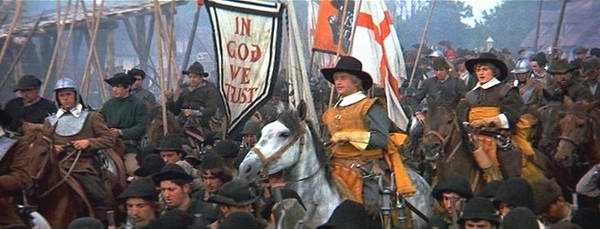
For my 200th Post here is the Sermon I am giving tomorrow morning. Here is the audio of the sermon (let me know if it works and how it sounds). The text is Matthew 28:16-20.
Linway United Presbyterian Church (U.S.A.) May 18, 2008
Scripture Lesson Matthew 28:16-20
Sermon “Baptizing and Teaching” Benjamin P. Glaser
Jesus in our Scripture lesson today is preparing to leave the Apostles and He is meeting with them here at a mountain in Galilee before his Ascension so that He can advise them what it is they are to do after He is no longer with them in the flesh. He tells them to go out and preach and teach and convert followers to Christ and to baptize them accordingly. One of the commands that Jesus gives them is that they are to make disciples among all the nations and it is here that I would like to focus your attention. If you could I would like you to get out your pink slip provided in your bulletin or open your Bible to the Scripture lesson in Matthew 28:16-20 and I am going to read again this short passage right now and I want you to think over it as I read it and as I preach this morning, especially verse 19 and I want you to think about what it means to be a disciple of Jesus Christ in light of this passage.
As a young child I was fascinated by how things worked. I would take apart my toys with screwdrivers and other tools to ascertain how exactly these things operated. I can remember one particular incident with my sister’s easy-bake oven. I had taken the little oven from her room and was sitting on the floor of my room and as I sat there with a screwdriver and a hammer I took the cover off and exposed the electric motor that operated the oven and as I sat there with the oven in various stages of unity I had the bright idea of plugging in the oven to see if it would become hot enough to melt some of the metal matchbox cars I owned. Well to make a long story short, it does and I have the scars to prove it. What I discovered that day, apart from the fact that a toy that it is made to cook actually gets hot enough to melt metal, is that I did not have the technical know-how to operate an easy-bake oven properly, of course one could say I just did not have the good sense to not take apart a working oven. One need not be anything more than a 6-year old to take things apart but to know how things work I needed more than just the tools of the trade I needed to have the know how. If one wants to become an electrician or a carpenter or a plumber or any type of trade you cannot just pick up a hammer and a nail and announce to the world that you are a carpenter. They’ll put you away. There is training you must go through, an apprentice time one must undergo, certifications you must receive and in many areas a union you must join to seek work as a carpenter. So why is it that we believe that all one needs to do to be a Christian, a follower of Christ is to just say, “Hey God I’m one of yours” and then go about your normal life claiming to be a follower of something and a member of something you have not studied or sought teaching about? Well this morning I want to talk with you about why it is we are called to do as apprentices to the Master who is Jesus Christ do and seek to study and know God’s word to his people given to us in His Word, the whole counsel of God not just the stuff we like, and why it is important in our day that when we are challenged by the ways of this world, when you are confronted at work by unbelievers who want to compromise your faith, when you are moved at school to violate the Laws of God that you have more than just a “well it’s a faith thing” answer as if faith is one way or another divorced from learning. One of the pitfalls we have made as a church is that we have somehow come to believe that Faith is antithetical to knowledge, that “science” or “truth” for that matter and “faith” have separate areas of responsibility. In other words we have moved from a place where we once believed as a Christian community that faith in Jesus Christ had a real knowledge component and that knowledge deeply affected our relationship with Christ to the place where “church” and “faith” are for our spiritual life and “science” is for our physical life. This over-reliance by most in the Church on science to answer questions that Scripture already has is an entirely different problem that we do not have time to get into this morning but there is a vibrant and rabid anti-intellectual movement within our community as believers in Christ and it is killing the church in America as it has already killed the church in Europe. The Apostle Paul in his writing to the Corinthian church in the first letter chapter 3 is confronting the same problem we have today in the church, the Corinthians have not moved passed where they were when he last saw them, beginning at verse 1“And I, brethren, could not speak to you as to spiritual men, but as to men of flesh, as to infants in Christ. I gave you milk to drink, not solid food; for you were not yet able to receive it. Indeed, even now you are not yet able, for you are still fleshly. For since there is jealousy and strife among you, are you not fleshly, and are you not walking like mere men?” What Paul is saying here is that there is more to the Christian life and the understanding of Christ but since you have chosen to continue in ignorance and apathy I cannot feed it to you because if I do you will be damaged. If we choose not to move past our infancy in our understanding of Christ how can we do as the Apostle Peter demands of his readers and for us today saying in his first epistle chapter 3 verse 15 that we must be able to “[give] an answer to everyone who asks you a reason for the hope that is in you…” It is not enough and it is not fair to Christ to give some convoluted and contrived answer to your unbelieving co-worker for the reason why you will not look at porn on their computer screen. As a disciple of Jesus Christ you need to be able to not just tell them why you will not scan their screen but to witness the Gospel to them so that they might believe as you have. This is what Christ is calling the Apostles to do and it is what he is calling us to do today not just in the church but in every area of our life.
One can hardly think the Apostles are ready for such a challenge. I mean was it not less than a week earlier that when their Master, Jesus Christ, had been arrested at Gethsemane that they had fled and hid in the wilderness so as to not be arrested themselves. Are these not the same Apostles that include Peter who had denied that he even knew whom Christ was? Or Thomas who doubted all that he had seen until he actual touched Christ’s physical wounds. How capable really are they to go and teach anyone anything? For one they are not exactly people who we would think would be much good at preaching and teaching. The majority of them barely have an elementary level education, they have not studied under the Rabbi’s or spent their days reflecting and studying the centuries of writings. These are mere fishermen, tax collectors, and a rag tag group of nobodies who have been chosen by Jesus Christ to go out into the world and teach and preach. How is it that Peter is to go and argue against the Jews and the Greeks who have had years of training in rhetoric, public speaking, apologetics, and philosophy? How can Stephen, who is soon to be martyred, stand up and counsel the Pharisees and the Sadducees as to the error of their ways and do so with conviction and confidence? They do so because they have an answer for the faith that is within them, the can do so because most importantly they believe what they are saying contains the words of Life, it is intrinsically what Christ himself had taught them so why should they not be ready to face the struggles and attacks of those who hate Christ? I am sure some of you are saying to yourself, “Well I am not Peter or Stephen” or “I have not had the luxury of sitting at the foot of Jesus” so I cannot hope to come to be able to do such things. Well you may not, like Stephen, ever be called in front of a Church court under the threat of death or you may never be walking around what is modern-day Syria and Turkey defending the faith against Greek philosophers and Jews like Peter. And you would be right to say you could not come to the knowledge that Peter or Stephen had if you do not take the time and the effort to become an apprentice, a disciple of Jesus Christ. Look again at verse 18 through 20, “And Jesus came up and spoke to [the Apostles], saying, "All authority has been given to Me in heaven and on earth. Go therefore and make disciples of all the nations, baptizing them in the name of the Father and the Son and the Holy Spirit, teaching them to observe all that I commanded you; and lo, I am with you always, even to the end of the age."
The word “disciple” as Matthew and others throughout the New Testament use it has a much deeper meaning than we usually inscribe for it. We could just as easily think of a disciple as a “pupil” or a “student”. The real meaning behind what we hear and what we read is that as disciples of Christ we are not meant to be just a follower, like one who follows around a band, the Apostles are not called by Christ to go out and create a sort of Jesus Christ groupie movement, but to go out and teach all that Christ had instructed them, all that the writers of the Older Testament had taught them and see to it that those who through a profession of faith had been moved by the Holy Spirit to proclaim faith in Christ are baptized in the name of the Father, and of the Son, and of the Holy Ghost. But their discipleship did not end with baptism it had just begun. In the Reformed faith we believe in baptizing infants not just because its pretty and cute but because we believe that in baptism we are bringing this child into a community of faith where the child will be brought up not only by believers but so that the child can become a believer, and not just that, we as a church make a promise that we will teach this child more than just their ABC’s of faith but that we will disciple them, making them students of Jesus Christ. The meaning of being a disciple of Jesus Christ calls us to be students of Christ, Christ is our teacher in the fullest sense of that word. Just as Christ taught the Apostles more than the basics so we should seek to know Christ at a much deeper level than just the nuts and bolts of faith. None of us after learning our ABC’s in kindergarten were able to obtain our High School diploma and go straight into college. There was much more involved in us receiving our High school diploma than just being taught our ABC’s and this is where we are as a church today. We have through the last 100 years or so dumbed down our religious life to the point that we are satisfied with our ABC’s, we are content with just coming to church on the Lord’s day and going home and not allowing the worship of Almighty God to crack through the insulated life that exist outside these four-walls, creating a compartmentalized faith that leaves Christ and his message for two hours each Sunday and maybe a prayer hear and there during the week. This is where Christ’s word to his Apostles strike us to the heart today in this very Service of Worship this morning. Why is it we are here? Are we here to be discipled or are we here to fulfill some kind of social responsibility? Why do we make ourselves get out of bed on Sunday morning when the rest of the world sleeps in? These are all questions we must answer for ourselves and these are questions that can only be answered if we seek ought to know them. Brother and Sisters in Christ I am here to tell you this morning that we are called as disciples of Jesus Christ that we are called to defend our faith and give not only ourselves a reason for being here but to give one to our unbelieving neighbors and family. Because if you cannot answer for the faith and hope that is within you why should anyone else believe either?
But before we trudge off to do the 37 other things we have planned for the Lord’s Day let us remember one thing. Today the session and the members here at Linway have brought these seven young people into the body of the visible church; you have brought these kids into the body of Christ. They are yet apprentices; their learning process has just begun. It is the job of this Church family to lead them and to teach them, discipling them in the way of the Christian Life, in how to properly understand the God whom we worship on the Lord’s Day, teaching them how to observe the Laws of God, teaching them how to observe the Sacrament of the Lord’s Supper, and so on and so forth. The primary teacher in their lives will be and should be the Church. While none of us will ever be the master, because Christ is the Master, we must strive not only to bring ourselves into a deeper and more complete understanding of the faith we confess to believe we must not only exemplify that faith to them through the works of our lives but also through the words we confess.
To God Alone Be the Glory, Amen.
Showing posts with label 1st Corinthians. Show all posts
Showing posts with label 1st Corinthians. Show all posts
Saturday, May 17, 2008


Wednesday, April 02, 2008
Slow and Steady Wins the Race; Paul's "Opinion"
It may take me till August to get through the Pastorals but I promise I will eventually do it. So here we are with the next section of 1st Timothy, 1 Tim 2:7. (No one can say the Pastorals lack good and full verses). Now it may seem off that I am choosing to isolate verse 7 of this chapter but I want to do so as to group together verses 8-15 for a full discussion on a very controversial passage in most circles. So without further ado here is 1st Timothy 2:7.
 Paul here is reminding both Timothy and the readers/hearers of this letter that he was appointed for three specific works by Christ on the road to Damascus. He was to be 1) a Preacher, 2) an Apostle, and 3) a Teacher of the Gentiles. Now to be sure while these offices are interrelated for Paul they are significantly different for Paul's ministry imparticular. For one Paul derives his authority to preach the Gospel from where? His time with Prof. Gamaliel, graduation from Jerusalem Theological Seminary, and ordination by the Presbytery of Tarsus? No! Paul receives his authority to preach from Jesus Christ himself!!! Paul is a full apostle with the same rights and privileges of the 12 Apostles present at Pentecost. This is vitally important when reading Paul's letters and listening to those who challenge Paul's authority, both at the Jerusalem Council in Acts 15 and today when "Professors" dismiss Paul's "personal thoughts" as mere opinion and conjecture which has no more weight than my own discretion. This is bubkus pure and simple. Who are we to challenge the words of an Apostle sent by Christ himself? Well simply to put it in words a 3rd grader could understand, Paul is an Apostle and we are not so it may be a good idea to listen to the Apostle's "opinion" and not our own.
Also worth thinking about is Paul's use of the word "this". For what is it that Paul has been appointed to teach and preach? To use Paul's own words in 1st Corinthians 15:1-19:
For this I was appointed a preacher and an apostle (I am telling the truth, I am not lying) as a teacher of the Gentiles in faith and truth.
Paul here is reminding both Timothy and the readers/hearers of this letter that he was appointed for three specific works by Christ on the road to Damascus. He was to be 1) a Preacher, 2) an Apostle, and 3) a Teacher of the Gentiles. Now to be sure while these offices are interrelated for Paul they are significantly different for Paul's ministry imparticular. For one Paul derives his authority to preach the Gospel from where? His time with Prof. Gamaliel, graduation from Jerusalem Theological Seminary, and ordination by the Presbytery of Tarsus? No! Paul receives his authority to preach from Jesus Christ himself!!! Paul is a full apostle with the same rights and privileges of the 12 Apostles present at Pentecost. This is vitally important when reading Paul's letters and listening to those who challenge Paul's authority, both at the Jerusalem Council in Acts 15 and today when "Professors" dismiss Paul's "personal thoughts" as mere opinion and conjecture which has no more weight than my own discretion. This is bubkus pure and simple. Who are we to challenge the words of an Apostle sent by Christ himself? Well simply to put it in words a 3rd grader could understand, Paul is an Apostle and we are not so it may be a good idea to listen to the Apostle's "opinion" and not our own.Also worth thinking about is Paul's use of the word "this". For what is it that Paul has been appointed to teach and preach? To use Paul's own words in 1st Corinthians 15:1-19:
Now I make known to you, brethren, the gospel which I preached to you, which also you received, in which also you stand, by which also you are saved, if you hold fast the word which I preached to you, unless you believed in vain. For I delivered to you as of first importance what I also received, that Christ died for our sins according to the Scriptures, and that He was buried, and that He was raised on the third day according to the Scriptures, and that He appeared to Cephas, then to the twelve. After that He appeared to more than five hundred brethren at one time, most of whom remain until now, but some have fallen asleep; then He appeared to James, then to all the apostles; and last of all, as to one untimely born, He appeared to me also. For I am the least of the apostles, and not fit to be called an apostle, because I persecuted the church of God. But by the grace of God I am what I am, and His grace toward me did not prove vain; but I labored even more than all of them, yet not I, but the grace of God with me. Whether then it was I or they, so we preach and so you believed. Now if Christ is preached, that He has been raised from the dead, how do some among you say that there is no resurrection of the dead. But if there is no resurrection of the dead, not even Christ has been raised; and if Christ has not been raised, then our preaching is vain, your faith also is vain. Moreover we are even found to be false witnesses of God, because we testified against God that He raised Christ, whom He did not raise, if in fact the dead are not raised. For if the dead are not raised, not even Christ has been raised and if Christ has not been raised, your faith is worthless; you are still in your sins. Then those also who have fallen asleep in Christ have perished. If we have hoped in Christ in this life only, we are of all men most to be pitied.
Wednesday, December 05, 2007
The Tabernacle and the New Testament Church
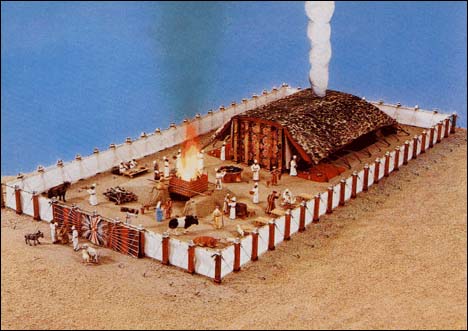
It is a hallmark of Reformed Worship that we believe that when two or more are gathered in the Name of the Father, Christ is with us. What we often fail to realize though when expressing this truth is how this ties directly into the relationship between the Israelite tabernacle and the New Testament, post-Easter and Ascension Church. Paul teaches us in 1st Corinthians 10:1-6 that God in Christ dwelled among us now as He did with the Jews in Sinai, in the Wilderness. Just as God fed the Israelities with spiritual food and spiritual drink God today feeds us through the indwelling of the Holy Spirit. The Tabernacle was God's house in the wilderness of Sinai. He commanded the Israelites to build this house as he instructed them so that God may have a proper place to dwell with his people. Just as God dwelled in the tabernacle of Sinai in the time of Moses, we are today still in the wilderness and God through and in and by his Church dwells among us. The Church can expect the presence of God, manifesting himself in Worship if we properly conduct ourselves in his Worship. But how do we do that?
Well first before I answer that question we have to ask ourselves what is the Church? Well the Church at its most basic is the bride of Christ. And what does Scripture say is one of the duties of the Bride to their Groom? To submit themselves to his authority and to serve him in love and gratitude. This use of the motif of the Bride and Groom is deeply rooted in Paul's theology and in the imagery Christ uses when describing his own relationship to the Church and his disciples. For example Jesus in the questions from Matt 9:14-16 to those who wondered why John's disciples fasted and the Pharisees fasted says,
"The attendants of the bridegroom cannot mourn as long as the bridegroom is withSo here we have an example of Christ using this archetype for the Church by comparing his disciples, those who follow him (i.e.- Christians), to his Bride-to-be. Now that Christ has died and arisen from the grave and ascended into Heaven his "marriage" to the Church has been consumated in this act. So we are to look at worship primarily as the relationship between Christ and his Bride, the Church.
them, can they? But the days will come when the bridegroom is taken away from
them, and then they will fast."
In this context we look at the ancient Tabernacle as being the example of what the particular church should be, not just a place of wood and stone (it is worth noting that a storefront or Middle School Gym is just as much a Tabernacle as a 15th Century cathedral or a sanctuary built in 1953) but a place where God comes to dwell with His people. The Church is God's special dwelling place, just as the Tabernacle was for the ancient Israelites.
Friday, October 26, 2007
Continuing my Walk
For the second installment of my walk of discernment I would like to highlight two past posts I have made on "Adam". They are not that old so some of you have already read them, but they serve our purpose well.
I thought a nice meaty topic would be in order so I want to discuss an issue that is bearing its head among colleagues and friends here at Pittsburgh Theological Seminary. That issue, as one can tell from the title, is whether or not Adam and Eve were actual beings, the Garden ever actually existed, and does "Original Sin" necessitate an "Original Sinner"? These are of course not new topics and though at first glance may seem to be third order worries I however take the position that without an actual Adam there would be no need for an actual Christ. So one could say that I hold this argument to be much more than a simple third order concern.
Why may you ask are people even doubting Adam's reality? Does not Paul in Romans 5:12 say that all sin came into the world through one man? Jesus himself refers to Adam and Eve in Matthew 19:4,5 not to mention Luke 3 records Adam as being in his geneology. Calvin in his commentary on the Pentateuch recalls that:
What do you think? Does a Christ automatically support an Adam? Or do we think that the story of Creation, without an actual Adam, is a proper myth that helps us and the early Israelites, Jesus, and the Apostles understand our current predicament and that an actual Adam is not required for the Cross?
*-All quotes taken from www.ccel.org
___________________________________________________________________
To continue the conversation about a literal Adam a little further let us examine how not having a "real" Adam destroys the need for an actual Christ. Those of you who do not believe in a physical Adam as expressed in the beginning chapters of Genesis need to reconcile how Christ, who Paul explicitly says in 1st Corinthians 15:42-49 is the second Adam, can be the so-called second of something that did not previously exist? Or put in other words how Adam being a metaphor calls for a Christ to die for a fake rebellion.
I think those of you who deny Adam's reality do not truly comprehend how much the idea of there being no Adam affects the rest of Scripture. It would be like taking away the opening chapter of a novel and expecting to be able to understand the rest of the story. Someone who describes the creation text as myth or folklore must analyze what this does not only to the history of God's relationship to Israel but to their Christology. Because not only does the non-existence of Adam necessitate that God created the world sinful and evil but it requires that Jesus' death on the cross is an action that resolves God's mistake in making an already fallen creation to himself. Not that Jesus was reconciling us, who share in Adam's rebellion, to God but that God was reconciling his own blunder with himself. Michal Horton in his work Putting Amazing Back Into Grace quotes John Calvin who says,"The depravity and malice both of men and of the devil, or the sins that arise therefrom, do not spring from nature, but rather from the corruption of nature." In other words it is not that nature itself was created evil but that nature had to of its own accord fall from the perfection in which it was formed to begin with. This has to mean that at some point in the past an "Adam" was given the free will to sin or as the Second Chapter of the Scots Confession defines it:
"We confess and acknowledge that our God has created man, i.e., our first father, Adam, after his own image and likeness, to whom he gave wisdom, lordship, justice, free will, and self-consciousness, so that in the whole nature of man no imperfection could be found. From this dignity and perfection man and woman both fell; the woman being deceived by the serpent and man obeying the voice of the woman, both conspiring against the sovereign majesty of God, who in clear words had previously threatened death if they presumed to eat of the forbidden tree."
For Jesus' death on the cross to be as Scripture says it to be necessitates a literal Adam who fell from God's grace. A fake Adam creates a Christ who has failed and is a liar. For what need do we have of a Savior that saves us from a death that was his fault to begin with? What do we say when we know that Christ did not die because of our own rebellion but because of his own mistake? How can we say that the literally hundreds of times Adam's sin is called upon by the writers of the Old Testament to show forth the sin of Israel is mere allegory? How can we say Christ died for an allegory or a metaphor and be taken seriously? Adam's reality is VITAL for the gospel to be real. Without an actual Adam our faith is in vain because Christ's atonement is nothing more than a big "sorry about that". This is not the message of the gospel.
I thought a nice meaty topic would be in order so I want to discuss an issue that is bearing its head among colleagues and friends here at Pittsburgh Theological Seminary. That issue, as one can tell from the title, is whether or not Adam and Eve were actual beings, the Garden ever actually existed, and does "Original Sin" necessitate an "Original Sinner"? These are of course not new topics and though at first glance may seem to be third order worries I however take the position that without an actual Adam there would be no need for an actual Christ. So one could say that I hold this argument to be much more than a simple third order concern.
Why may you ask are people even doubting Adam's reality? Does not Paul in Romans 5:12 say that all sin came into the world through one man? Jesus himself refers to Adam and Eve in Matthew 19:4,5 not to mention Luke 3 records Adam as being in his geneology. Calvin in his commentary on the Pentateuch recalls that:
So God created man The reiterated mention of the image of God is not a vain repetition. For it is a remarkable instance of the Divine goodness which can never be sufficiently proclaimed. And, at the same time, he admonishes us from what excellence we have fallen, that he may excite in us the desire of its recovery.*Or Abraham Kuyper:
Like Job, we ought to feel and to acknowledge that in Adam you and I are created; when God created Adam He created us; in Adam’s nature He called forth the nature wherein we now live. Gen. i. and ii. is not the record of aliens, but of ourselves—concerning the flesh and blood which we carry with us, the human nature in which we sit down to read the Word of God.Or A.W. Pink:
Now, strictly speaking, there are only two men who have ever walked this earth which were endowed with full and unimpaired responsibility, and they were the first and last Adam's. The responsibility of each of the rational descendants of Adam, while real, and sufficient to establish them accountable to their Creator is, nevertheless, limited in degree, limited because impaired through the effects of the Fall.Or Charles Hodge:
We are inherently depraved, and therefore we are involved in the guilt of Adam’s sin.So here we have Scripture, greats of the Reformation, and contemporary scholars all pointing to a real Adam. So why do Orthodox people seem inclined to accept that Adam was a real being but we of 2007 seem not to think it either necessary or true? Is it because these old white men did not have access to "knowledge" that we have today and if they just knew about textual criticism, historical criticism, literary criticism, grammatical criticism, and J, E, P, and D then they would also see the "mythical" properties of the creation text? Well would Calvin change his mind on the necessity of Adam's fall for the reality of Christ's death if he knew of the Yahwist? The easy answer is to say that proponents of the allegory hypothesis are so taken by accommodation with the sciences that their theistic evolutionary stance forces them to concede that no "Adam" ever existed, regardless of what this position does to their theology, because science has proved Homo Sapiens developed independently. But is this answer sufficient? Is it just simple to say that those who hold there is no Adam because of the supposed inconsistencies in the Hebrew and the alleged "two creations" are "wrong" without delving deeper into the questions behind this stance?
What do you think? Does a Christ automatically support an Adam? Or do we think that the story of Creation, without an actual Adam, is a proper myth that helps us and the early Israelites, Jesus, and the Apostles understand our current predicament and that an actual Adam is not required for the Cross?
*-All quotes taken from www.ccel.org
___________________________________________________________________
To continue the conversation about a literal Adam a little further let us examine how not having a "real" Adam destroys the need for an actual Christ. Those of you who do not believe in a physical Adam as expressed in the beginning chapters of Genesis need to reconcile how Christ, who Paul explicitly says in 1st Corinthians 15:42-49 is the second Adam, can be the so-called second of something that did not previously exist? Or put in other words how Adam being a metaphor calls for a Christ to die for a fake rebellion.
I think those of you who deny Adam's reality do not truly comprehend how much the idea of there being no Adam affects the rest of Scripture. It would be like taking away the opening chapter of a novel and expecting to be able to understand the rest of the story. Someone who describes the creation text as myth or folklore must analyze what this does not only to the history of God's relationship to Israel but to their Christology. Because not only does the non-existence of Adam necessitate that God created the world sinful and evil but it requires that Jesus' death on the cross is an action that resolves God's mistake in making an already fallen creation to himself. Not that Jesus was reconciling us, who share in Adam's rebellion, to God but that God was reconciling his own blunder with himself. Michal Horton in his work Putting Amazing Back Into Grace quotes John Calvin who says,"The depravity and malice both of men and of the devil, or the sins that arise therefrom, do not spring from nature, but rather from the corruption of nature." In other words it is not that nature itself was created evil but that nature had to of its own accord fall from the perfection in which it was formed to begin with. This has to mean that at some point in the past an "Adam" was given the free will to sin or as the Second Chapter of the Scots Confession defines it:
"We confess and acknowledge that our God has created man, i.e., our first father, Adam, after his own image and likeness, to whom he gave wisdom, lordship, justice, free will, and self-consciousness, so that in the whole nature of man no imperfection could be found. From this dignity and perfection man and woman both fell; the woman being deceived by the serpent and man obeying the voice of the woman, both conspiring against the sovereign majesty of God, who in clear words had previously threatened death if they presumed to eat of the forbidden tree."
For Jesus' death on the cross to be as Scripture says it to be necessitates a literal Adam who fell from God's grace. A fake Adam creates a Christ who has failed and is a liar. For what need do we have of a Savior that saves us from a death that was his fault to begin with? What do we say when we know that Christ did not die because of our own rebellion but because of his own mistake? How can we say that the literally hundreds of times Adam's sin is called upon by the writers of the Old Testament to show forth the sin of Israel is mere allegory? How can we say Christ died for an allegory or a metaphor and be taken seriously? Adam's reality is VITAL for the gospel to be real. Without an actual Adam our faith is in vain because Christ's atonement is nothing more than a big "sorry about that". This is not the message of the gospel.
Thursday, September 13, 2007
Education Is The Answer
As the summer time in America is ending and we are starting again a brand new school year. We end the time that has traditionally become the occasion when America takes a collective break from learning. Our schools from Head Start to the Graduate level for the most part shut down, excepting the underachievers like myself who spend their more formative summers in High School relearning Algebra and Geometry. Also in our Churches we usually suspend organized Sunday school programs at the end of May awaiting the fall kick off of a new standard program with the weeklong VBS program in the middle. This is the way Church education has been done for as long as anyone of us can remember. One of the things that have always distinguished Presbyterians is our focus on Education. English Puritans who saw in the academy a place where they could help enable the colonies to grow founded many of the oldest collegiate institutions in the United States. Because they rightly understood that the fate of the American enterprise lay more in the time spent engaging the young minds under their care than in measuring the sweat on their backs. As early as 1642 the Massachusetts Bay Colony had already established compulsory education up through what today we would call 4th grade. Virtually all of the schools established above this level were founded for the training of ministers and for the study of theology. It was not a coincidence that the founders of this country thought to build theological schools before laying the plans for the first law schools and programs for engineering. This was because our forefathers understood the need for us to not just have a cursory knowledge of the Scriptures but to be able to dialogue with one another concerning more intensive and developed Doctrine. It was expected in that day that before someone could became an officer of the Church that they would know the Westminster Standards and be able to defend their faith when called upon. It is interesting to note that the Westminster Shorter Catechism was designed for children and the illiterate to be used to help them know what it was they believed given that its form as short question and answers would be easily memorized. The church kept up this practice for centuries until the recent past. Unfortunately we have grown from that proud heritage to place today where we live in a time of intellectual and educational apathy. We have lost the value of not only theological education but familial education as well. We see denominational records of Sunday school attendance dropping like the Stock Market in 1929. In 1950 the average Presbyterian Church could expect 80% of its membership to attend Sunday school. Today the average is in the high teens. You might be wondering now why attendance in Sunday School has fallen so in the past 60 years in the church? But before we do that let us look at what Paul has to say in the 3rd chapter of Corinthians.
The city of Corinth in the time of Paul and the Apostles was a city of great wealth and stature. It sat on an isthmus between the two geographic centers of Greece and was a center for cultic worship and was the birthplace of many a false prophet. Paul in verse one through three of today’s Scripture lesson says to the Corinthians, “And I, brethren, could not speak to you as to spiritual men, but as to men of flesh, as to infants in Christ. I gave you milk to drink, not solid food; for you were not yet able to receive it. Indeed, even now you are not yet able, for you are still fleshly. For since there is jealousy and strife among you, are you not fleshly, and are you not walking like mere men?” Paul here is speaking to a Corinthian Church that is mired in dissension and confusion. The Church is being destroyed by infighting over the loves of the flesh, infighting that according to Paul arises out of their misunderstanding of who God is. They have confused the all-powerful God which the Westminster Confession of Faith claims is, “The one and only living and true God, who is infinite in being and perfection… not standing in need of any creatures which he has made, nor deriving any glory from them, but only manifesting his own glory in, by, unto, and upon them; he is alone foundation of all being” for a God who is muted in power and seeks only to make us comfortable and safe. Paul continues in verses four through seven trying to get the Corinthian Church to understand the importance of knowing and understanding the power of Almighty God pleading with them, “For when one says, "I am of Paul," and another, "I am of Apollos," are you not mere men? What then is Apollos? And what is Paul? Servants through whom you believed, even as the Lord gave opportunity to each one. I planted, Apollos watered, but God was causing the growth. So then neither the one who plants nor the one who waters is anything, but God who causes the growth.” While some are claiming to be followers of Paul and others followers of Apollos they miss the point that Paul and Apollos are mere servants of the Almighty God, the Creator of all things who alone should be the object of their worship. The Corinthians as Paul says have not moved past the basic nourishment of their mother’s milk. They cannot yet take in the meat of the Gospel because they have not trained their bodies to receive it. In other words the Corinthians cannot accept the meat of the Gospel because they refuse to turn their flesh over to God. They seek the pleasures of their own flesh up and over the glorious food of the Gospel. The Gospel is there for the Corinthians to have but they choose to not have the Gospel so as to not alienate them from their brethren. Paul later in chapter three verse eighteen says, “Let no man deceive himself If any man among you thinks that he is wise in this age, he must become foolish, so that he may become wise. For the wisdom of this world is foolishness before God” You see the problem with the Corinthian church, the problem that leads to their infighting, is that they do not seek the wisdom of God but are purely satisfied by the unfulfilling wisdom of this world. They cannot move past the milk that Paul has given them because they are not interested in learning any more. They have become apathetic to the teaching and learning of the Word of God. One of the leading causes of death in areas of Africa where famine is hitting the hardest is a condition where the body after being deprived of proper nutrition for so long that it cannot now properly break down complex carbohydrates and proteins. The body then rejects this meat causing internal damage and eventually death. The flesh cannot handle what the spirit is not ready to receive. The Apostle Paul tells the Corinthians that they cannot receive this meat because they are as he puts it “still too fleshly”. What does it mean to be too fleshly? Well we know that the Church in Corinth is still beholding themselves to the wisdom of the age. They refuse to put behind them the wisdom of the Greek for the understanding of God. In their childlike intake of Greek culture and education they refuse to deny themselves take up their cross and follow Christ and Christ alone. They fail to receive the meat of the Gospel because they have refused to be taught by Paul any more than what they already know. Because as long as I know a little bit that’s enough right? Why should I strive to know more than the basics? Paul addresses this as well later in this letter to the Corinthians when he says in chapter fourteen verse twenty, “Brethren, do not be children in your thinking…but in your thinking be mature.” We have been called to move past the childlike faith of our past so that we can live on the nourishment that is the Gospel of Jesus Christ. To paraphrase Luke writing in Acts it would not be good of us to neglect the understanding and teaching of the Word so that we can endeavor to other things but we should strive first and foremost to have a deeper and more luscious desire to know the Word of God.
A former Professor at Pittsburgh Theological Seminary by the name of Dr. John Gerstner published a book in 1965 with the title “Theology for Everyman”. In this work Dr. Gerstner makes the outrageous claim that every person who declares themselves to be a follower of Christ should be at least, an amateur theologian. He makes the case that not all people are called to be able to understand the craft of plumbers or the intricacies of computer engineering or even the value of housework but all who are called to follow Christ are called to know Christ and his Word. Dr. Gerstner in his work says,” Is it not clear why a layman must necessarily be a theologian? Is there anyone, layman or otherwise, who does not need to know God? Does the Scripture not say, “This is life eternal, that they might know thee the only true God, and Jesus Christ, whom thou has sent” (John 17:3)? It is, then, no mere option with a layman whether he will be a theologian or not, whether he will have eternal life or not; it is no option with him whether he will know God or not. The knowledge of God is necessary to eternal life. And if eternal life is necessary for every man, then theology is also necessary for every man.” In other words just knowing who Jesus Christ is not enough. We have to be able to understand our faith at level more deeply than just cursory knowledge. Passing off the study of Scripture as being “boring” or being the job of the pastor is not good enough. I cannot tell you how many times in my young life I have heard people say that it is the job of the minister to know the Word and understand Doctrine so that I do not have to. Friends that is severely misguided. If we are to be believers in Jesus Christ we have to know his Word. You have to be able to understand the profundity of human depravity and sinfulness if you are going to be able to appreciate the full measure of the mercy and the depths to which Jesus Christ went to on the cross to save us. You have to be able to give a defense of your faith to the unbelievers of this world. How can we fulfill the mission of Matthew 28 if we do not know Scripture? How can we teach people about Jesus Christ if we ourselves cannot speak to the power of the infallible Word of God? We must not follow in the footsteps of the Corinthian Church who allowed themselves to be beholden to the wisdom of this age. For as Moses pleads with to the Israelites to understand in Deuteronomy 8:3 to know about the God that loves them and provides for them as they wander in the desert, "He humbled you and let you be hungry, and fed you with manna which you did not know, nor did your fathers know, that He might make you understand that man does not live by bread alone, but man lives by everything that proceeds out of the mouth of the LORD.”
We must not be afraid of knowing Christ through his Word. We must not allow the apathy and anti-intellectualism of this age towards the Word of God overtake us. We must thirst for the nourishment that comes from reading and studying the Word of God. Do not consume the wisdom of this age for the Lord our God has come to do away with the wisdom of this world providing for us the Wisdom of the Almighty so that as the Israelites in the Desert we may not be famished by our lack of knowledge but may be filled with the faith and trust of the Holy Spirit.
Tuesday, August 14, 2007
Understanding Adam's Rebellion
To continue the conversation about a literal Adam a little further let us examine how not having a "real" Adam destroys the need for an actual Christ. Those of you who do not believe in a physical Adam as expressed in the beginning chapters of Genesis need to reconcile how Christ, who Paul explicitly says in 1st Corinthians 15:42-49 is the second Adam, can be the so-called second of something that did not previously exist? Or put in other words how Adam being a metaphor calls for a Christ to die for a fake rebellion.
I think those of you who deny Adam's reality do not truly comprehend how much the idea of there being no Adam affects the rest of Scripture. It would be like taking away the opening chapter of a novel and expecting to be able to understand the rest of the story. Someone who describes the creation text as myth or folklore must analyze what this does not only to the history of God's relationship to Israel but to their Christology. Because not only does the non-existence of Adam necessitate that God created the world sinful and evil but it requires that Jesus' death on the cross is an action that resolves God's mistake in making an already fallen creation to himself. Not that Jesus was reconciling us, who share in Adam's rebellion, to God but that God was reconciling his own blunder with himself. Michal Horton in his work Putting Amazing Back Into Grace quotes John Calvin who says,"The depravity and malice both of men and of the devil, or the sins that arise therefrom, do not spring from nature, but rather from the corruption of nature." In other words it is not that nature itself was created evil but that nature had to of its own accord fall from the perfection in which it was formed to begin with. This has to mean that at some point in the past an "Adam" was given the free will to sin or as the Second Chapter of the Scots Confession defines it:
"We confess and acknowledge that our God has created man, i.e., our first father, Adam, after his own image and likeness, to whom he gave wisdom, lordship, justice, free will, and self-consciousness, so that in the whole nature of man no imperfection could be found. From this dignity and perfection man and woman both fell; the woman being deceived by the serpent and man obeying the voice of the woman, both conspiring against the sovereign majesty of God, who in clear words had previously threatened death if they presumed to eat of the forbidden tree."
For Jesus' death on the cross to be as Scripture says it to be necessitates a literal Adam who fell from God's grace. A fake Adam creates a Christ who has failed and is a liar. For what need do we have of a Savior that saves us from a death that was his fault to begin with? What do we say when we know that Christ did not die because of our own rebellion but because of his own mistake? How can we say that the literally hundreds of times Adam's sin is called upon by the writers of the Old Testament to show forth the sin of Israel is mere allegory? How can we say Christ died for an allegory or a metaphor and be taken seriously? Adam's reality is VITAL for the gospel to be real. Without an actual Adam our faith is in vain because Christ's atonement is nothing more than a big "sorry about that". This is not the message of the gospel.
I think those of you who deny Adam's reality do not truly comprehend how much the idea of there being no Adam affects the rest of Scripture. It would be like taking away the opening chapter of a novel and expecting to be able to understand the rest of the story. Someone who describes the creation text as myth or folklore must analyze what this does not only to the history of God's relationship to Israel but to their Christology. Because not only does the non-existence of Adam necessitate that God created the world sinful and evil but it requires that Jesus' death on the cross is an action that resolves God's mistake in making an already fallen creation to himself. Not that Jesus was reconciling us, who share in Adam's rebellion, to God but that God was reconciling his own blunder with himself. Michal Horton in his work Putting Amazing Back Into Grace quotes John Calvin who says,"The depravity and malice both of men and of the devil, or the sins that arise therefrom, do not spring from nature, but rather from the corruption of nature." In other words it is not that nature itself was created evil but that nature had to of its own accord fall from the perfection in which it was formed to begin with. This has to mean that at some point in the past an "Adam" was given the free will to sin or as the Second Chapter of the Scots Confession defines it:
"We confess and acknowledge that our God has created man, i.e., our first father, Adam, after his own image and likeness, to whom he gave wisdom, lordship, justice, free will, and self-consciousness, so that in the whole nature of man no imperfection could be found. From this dignity and perfection man and woman both fell; the woman being deceived by the serpent and man obeying the voice of the woman, both conspiring against the sovereign majesty of God, who in clear words had previously threatened death if they presumed to eat of the forbidden tree."
For Jesus' death on the cross to be as Scripture says it to be necessitates a literal Adam who fell from God's grace. A fake Adam creates a Christ who has failed and is a liar. For what need do we have of a Savior that saves us from a death that was his fault to begin with? What do we say when we know that Christ did not die because of our own rebellion but because of his own mistake? How can we say that the literally hundreds of times Adam's sin is called upon by the writers of the Old Testament to show forth the sin of Israel is mere allegory? How can we say Christ died for an allegory or a metaphor and be taken seriously? Adam's reality is VITAL for the gospel to be real. Without an actual Adam our faith is in vain because Christ's atonement is nothing more than a big "sorry about that". This is not the message of the gospel.
Saturday, February 25, 2006
Christian Worship
I have been doing a lot of studying this week on music and its place in worship. I found this article online and though I may not agree 100% with the author's conclusions I found it to be quite helpful.
http://www.apuritansmind.com/PuritanWorship/
McMahonGodFaddishNostalgic.htm
Here are a couple quotes that I personally believe to be spot on.
"First, it is to be orderly. 1 Corinthians 14:40 says, “Let all things be done decently and in order.” In the immense madness that characterized the Corinthian church and its chaotic worship, the Apostle took great lengths to order their worship. God is a God of order, not frenzy. Screaming up and down the church isles, rolling in the aisle, dancing around the sanctuary is not orderly. Nothing the church does in a worship service should distract other worshippers from worshipping God..."
"God alone determines how sinners approach Him. As a matter of fact, God determines how human beings or angelic beings approach Him as well. As Christians, we must continue to use God’s judgments, commandments and statutes as a rule and line to be drawn against anything which does not have a plain and divine appointment for worship."
http://www.apuritansmind.com/PuritanWorship/
McMahonGodFaddishNostalgic.htm
Here are a couple quotes that I personally believe to be spot on.
"First, it is to be orderly. 1 Corinthians 14:40 says, “Let all things be done decently and in order.” In the immense madness that characterized the Corinthian church and its chaotic worship, the Apostle took great lengths to order their worship. God is a God of order, not frenzy. Screaming up and down the church isles, rolling in the aisle, dancing around the sanctuary is not orderly. Nothing the church does in a worship service should distract other worshippers from worshipping God..."
"God alone determines how sinners approach Him. As a matter of fact, God determines how human beings or angelic beings approach Him as well. As Christians, we must continue to use God’s judgments, commandments and statutes as a rule and line to be drawn against anything which does not have a plain and divine appointment for worship."
Subscribe to:
Posts (Atom)